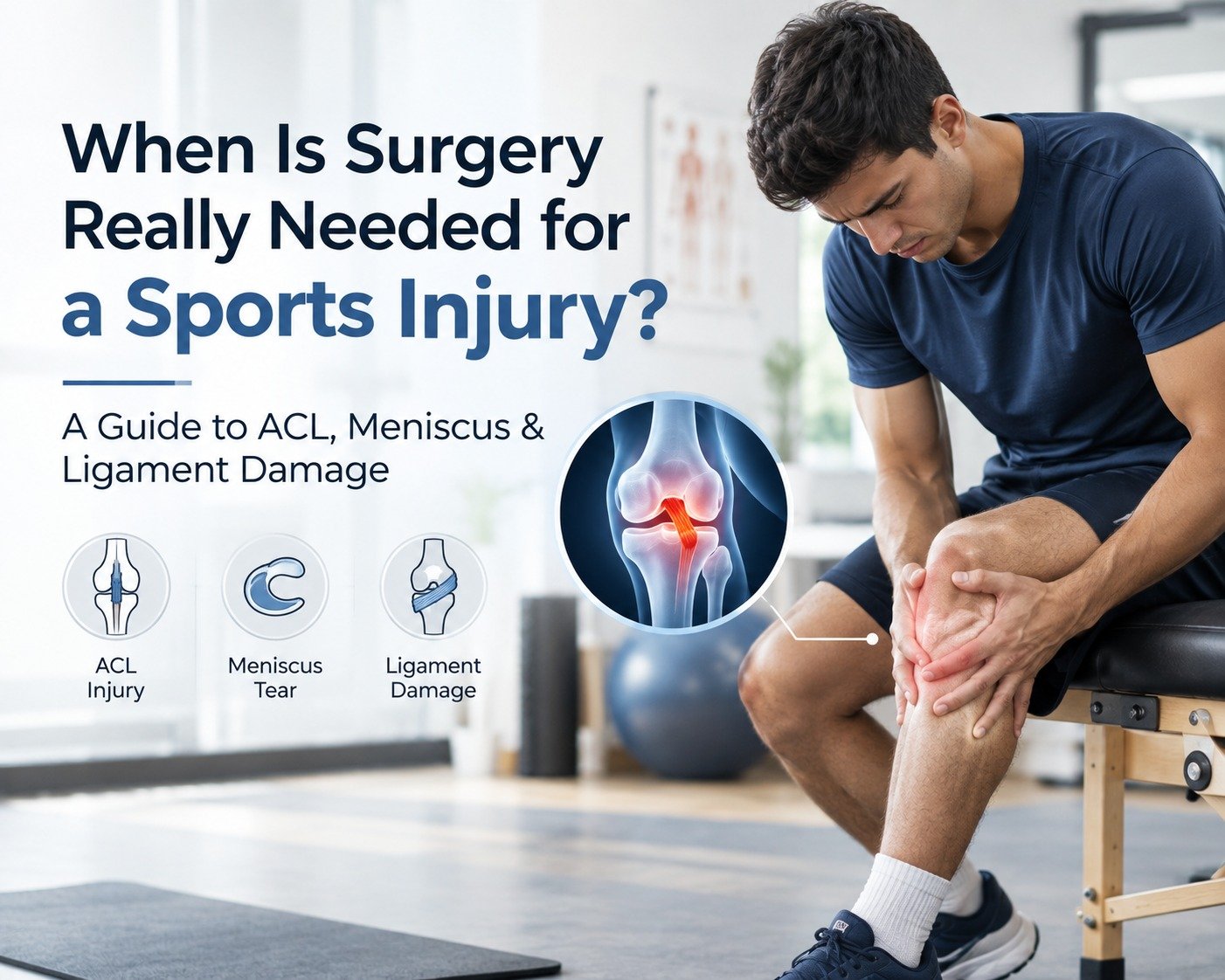
A sports injury does not automatically mean surgery. A sudden twist, awkward landing, collision or fall can damage the knee in different ways, including the ACL, meniscus or other ligaments. While some injuries improve with physiotherapy, activity modification, bracing and other non-surgical treatments, certain injuries may require surgical intervention to restore stability and function. One of the most common concerns among athletes and active individuals is: “How do I know if my sports injury needs surgery?” The answer depends on several factors, including the type and severity of the injury, knee stability, symptoms, activity level, associated damage and response to rehabilitation. If you have persistent knee pain, repeated swelling, locking or a feeling that your knee is giving way after a sports injury, an evaluation by an experienced orthopaedic and sports injury specialist in Delhi NCR can help determine the right treatment approach.
What Are the Most Common Sports Injuries That May Need Surgery?
Sports injuries can affect muscles, tendons, cartilage and ligaments. However, some knee injuries are more frequently associated with surgical treatment.
1. ACL Injury
The anterior cruciate ligament (ACL) is one of the major stabilising ligaments inside the knee. It helps control forward movement and rotation of the knee. ACL injuries commonly occur during football, basketball, cricket, badminton, skiing, running or other activities involving sudden changes in direction, pivoting or awkward landings.
A torn ACL may cause:
- A popping sensation at the time of injury
- Rapid swelling of the knee
- Difficulty bearing weight
- Knee instability or giving way
- Difficulty running or changing direction
- Reduced confidence while playing sports
Not every ACL injury requires immediate surgery. Treatment is influenced by the degree of instability, the person's activity level, associated injuries and future sports goals. Active individuals involved in pivoting sports may be more likely to benefit from ACL reconstruction when the knee remains unstable.
2. Meniscus Tear
The menisci are two crescent-shaped pieces of cartilage between the thigh bone and shin bone. They act as shock absorbers and help distribute load across the knee. A meniscus tear can happen because of a twisting movement, sudden change in direction, deep squatting or a sports-related impact.
Common symptoms include:
- Pain along the side or joint line of the knee
- Swelling
- Clicking or catching
- Difficulty bending or straightening the knee
- A sensation of locking
- Pain while squatting or climbing stairs
Many meniscus tears can initially be managed without surgery, particularly when symptoms are mild and the knee is not locking or significantly limiting function. However, a painful tear that causes persistent symptoms or restricts knee movement may require surgical assessment. When surgery is appropriate, preserving as much healthy meniscus tissue as possible is generally an important consideration.
3. Other Ligament Injuries
The knee contains several important ligaments, including the ACL, PCL, MCL and LCL. Depending on the injury, one or multiple ligaments can be affected. A partial ligament injury may sometimes respond well to structured rehabilitation. However, a complete tear, significant instability or combined ligament injury may require surgery. This is particularly important for athletes who want to return to activities involving running, jumping, pivoting or sudden changes in direction.
When Is Surgery Really Needed for a Sports Injury?
There is no single symptom that automatically means surgery is required. Instead, an orthopaedic specialist considers the complete clinical picture.
Persistent Knee Instability
If the knee repeatedly gives way while walking, running, climbing stairs or playing sports, it may indicate significant ligament instability. Repeated episodes of instability can also place additional stress on other structures of the knee. Therefore, persistent instability should not simply be ignored.
Locking of the Knee
A knee that becomes mechanically locked or cannot fully straighten may indicate an internal structural problem, including certain meniscus tears or loose fragments. Persistent locking or restricted movement should be evaluated rather than managed through prolonged self-treatment.
Failure of Appropriate Non-Surgical Treatment
Surgery may be considered when an appropriate period of conservative treatment has failed to improve symptoms or function. Non-surgical treatment may include:
- Activity modification
- Physiotherapy
- Strengthening exercises
- Mobility and flexibility work
- Bracing where appropriate
- Pain and swelling management
- Gradual return-to-activity rehabilitation
The goal is not simply to reduce pain but to restore strength, movement, stability and function.
Complete or Significant ACL Tear in an Active Person
A complete ACL tear does not automatically mean every person needs reconstruction. However, surgery is commonly considered in active individuals who experience instability or want to return to sports involving pivoting and rapid directional changes. For some patients, rehabilitation may provide sufficient stability for daily activities. The decision should therefore be individualised rather than based on an MRI report alone.
Combined Injuries
Sometimes an athlete does not have just one injury. An ACL tear may occur together with a meniscus, cartilage or additional ligament injury. When multiple structures are damaged, the overall treatment plan may be more complex. In selected cases, associated injuries can be treated during the same surgical procedure.
Does Every ACL Tear Need Surgery?
No. This is one of the most important points to understand. An ACL injury should not be treated based only on the words “ACL tear” appearing on an MRI report. The doctor also considers:
- Whether the tear is partial or complete
- Knee stability
- Symptoms and functional limitations
- Age and general health
- Sports and physical activities
- Associated meniscus or cartilage injuries
- Response to rehabilitation
- Future activity goals
A person who does not participate in high-demand sports and has a stable knee may sometimes manage the injury without reconstruction. On the other hand, an active athlete with persistent instability who wants to return to football, cricket, basketball, badminton or similar pivoting sports may be considered for ACL reconstruction.
How Is a Sports Injury Diagnosed?
An accurate diagnosis is the first step toward deciding whether surgery is appropriate.
A sports injury evaluation generally includes a detailed medical history and physical examination. The specialist may assess:
- Range of motion
- Knee stability
- Swelling
- Tenderness
- Muscle strength
- Walking pattern
- Functional limitations
Depending on the suspected injury, imaging such as an X-ray or MRI may be recommended. MRI can provide useful information about soft-tissue structures such as the ACL, meniscus, cartilage and other ligaments. However, treatment decisions should combine imaging findings with symptoms and clinical examination.
What Is Arthroscopy in Sports Injury Treatment?
Arthroscopy is a minimally invasive surgical technique used for selected joint problems. A small camera is inserted through a small incision, allowing the surgeon to view the inside of the joint.
Depending on the injury, arthroscopic procedures may be used for:
- ACL reconstruction
- Meniscus repair
- Treatment of selected cartilage problems
- Management of certain ligament injuries
- Removal of loose bodies
The exact procedure depends on the injury and the patient's individual requirements. However, minimally invasive surgery does not mean that rehabilitation is unnecessary. Recovery after sports injury surgery involves structured physiotherapy, strengthening, mobility work and gradual progression toward normal activities and sport.
How Long Does Recovery Take After Sports Injury Surgery?
Recovery varies significantly from person to person.
It depends on:
- Type of surgery
- Severity of injury
- Whether multiple structures were treated
- Muscle strength
- Physiotherapy adherence
- Overall health
- Type of sport
- Functional recovery
For ACL reconstruction, returning to competitive sport should not be based only on a fixed number of weeks or months. Strength, movement control, stability, confidence and sport-specific readiness should also be assessed. Returning to sports too quickly may increase the risk of complications or reinjury.
Can Sports Injuries Be Treated Without Surgery?
Yes, many can. Not every sports injury requires an operation. Depending on the diagnosis, treatment may involve physiotherapy, rehabilitation, temporary activity modification, bracing, medication when appropriate and a gradual return to activity. For example, some stable ligament injuries, mild strains, selected meniscus tears and overuse-related problems may improve with conservative management. The important point is to identify the actual injury before deciding between surgery and non-surgical treatment.
Why You Should Not Ignore a Repeated Sports Injury
Athletes sometimes return to sports as soon as pain decreases. However, reduced pain does not always mean the underlying injury has fully recovered. Continuing to play with an unstable knee can potentially aggravate symptoms or cause additional damage. If your knee repeatedly swells after activity, gives way, locks or remains painful despite appropriate rehabilitation, it is worth getting a professional assessment.
Choosing the Right Sports Injury Specialist in Delhi NCR
If you are searching for sports injury treatment in Delhi NCR, look for an orthopaedic specialist who evaluates the complete injury rather than recommending surgery solely because an MRI shows a tear.
A good treatment plan should answer three important questions:
What exactly is injured?
Does the injury require surgery?
What is the safest route back to normal activity or sport?
For patients in Delhi NCR, an experienced sports injury and orthopaedic specialist can assess ACL tears, meniscus injuries, ligament damage, knee instability and other sports-related conditions and recommend treatment based on individual needs.
Conclusion
A sports injury does not automatically mean you need surgery. The right treatment depends on the type of injury, severity, symptoms, knee stability, activity level, associated damage and response to rehabilitation. ACL tears, meniscus injuries and ligament damage can often be managed through different treatment approaches and surgery is considered when it is likely to provide a meaningful functional benefit. If you are experiencing persistent knee pain, swelling, locking, instability or repeated giving way after a sports injury, consult an orthopaedic sports injury specialist in Delhi NCR for a proper examination and personalised treatment plan. Early and accurate assessment can help you understand your injury and make an informed decision about rehabilitation or surgery.
Frequently Asked Questions
1. Does every ACL tear require surgery?
No. The need for ACL surgery depends on knee stability, activity level, associated injuries, symptoms and future sports goals.
2. Can a meniscus tear heal without surgery?
Some meniscus tears can improve with non-surgical treatment. Surgery may be considered when symptoms persist, the knee locks or the tear is suitable for surgical treatment.
3. What are the signs that a sports injury may need surgery?
Repeated knee instability, persistent pain, mechanical locking, significant movement restriction or failure of appropriate rehabilitation may lead a specialist to consider surgery.
4. Is MRI necessary for an ACL or meniscus injury?
MRI can be very useful for assessing soft-tissue injuries, but the diagnosis and treatment plan should also consider the physical examination and symptoms.
5. How soon can I return to sports after ACL surgery?
There is no universal timeline. Return to sport depends on healing, strength, stability, movement quality, rehabilitation progress and sport-specific readiness.
6. Should I see a doctor if my knee keeps giving way?
Yes. Repeated giving way can indicate knee instability and should be evaluated by an orthopaedic or sports injury specialist.